The North Coast Knifemaking Club undertook to host the first-ever Bladesports cutting competition event in KZN in September 2019.

Bladesports, probably thanks to History Channel’s popular series “Forged in Fire” and “Knife or Death”, is taking off around the world and even here in South Africa, where there are aspirations to grow the event at provincial and national levels. Maybe even competing internationally???
Despite Bladesports being over 30 years old, there is not a lot of information available on what makes the perfect Competition Chopper. Given the competitive nature of the sport, this is not surprising as people are guarding their hard-won experience and competitive advantages but there are well-known US competitors like Big Chris, Big D Knives, and Jose Diaz to name a few, whose knives serve as great examples of high-performance designs.
My initial design shared a number of parallels to Dan Keffeler’s design as his overall design matched my initial sketches and ideas on what a good competition chopper should be, quite closely to boot.
On June 20, 2010, Dan Keffeler broke the 2×4 speed cut record (1.21 sec).
Certainly, a good pedigree to start from.
International Bladesport Specifications:
- Blade Length – 10″ (measured from the front of the handle to the blade tip)
- Overall Length – 15″ (measured from the back of the handle to the blade tip)
- Blade Width – 2″ (measured at the widest part of the blade)
- Blade and Handle Thickness – No restrictions
Design Concepts
The belly increases the knife’s ability to both slice and slash. It presents an ever-changing angle to the material being cut, and this means slicing efficiency is preserved across the cut. Most feel that too pronounced a curve may push objects away rather than cutting them, leading to most competition blades having a flat cutting edge. Axes are synonymous with cutting wood, so I incorporated a slightly curved edge into my design. When watching videos of competitors, it’s the 2×4 cuts where most people lose time. So why not make it easier for yourself?
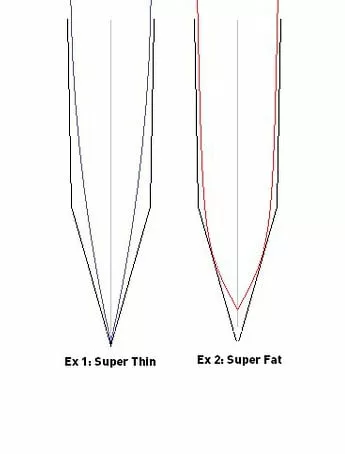
The thickness of the edge is another tradeoff in strength vs. cutting ability. The thinner the edge, the better it will cut, but a thin edge is weak and can chip out or roll over faster than a thick edge. A thick edge is stronger but doesn’t cut as well.
An Apple Seed edge or the convex grind is recognized as the best blade geometry option for a competition chopper as it keeps a little “meat” behind the edge for stability. I have seen some flat grinds and even some hollow grinds out there in use that have held up very well in the competition, which shows that there are many ways to “skin a cat”. I went with the apple seed edge with zero secondary bevels which I polished on water-stones up to #4000 grit and finished with a leather strop.
Another way to improve slicing, slashing, or chopping performance without introducing the hard-to-sharpen / illegal recurved blade is by playing with the angles between the edge and handle. One way to do this is with a positive included angle, where the edge at its lowest point is below the handle. This is a bit harder to achieve with a competition-style chopper given the max height of the blade. Another method would be to change the angle between the blade and handle. This can change the ergonomics for the better on some designs. If you look at Jose Diaz’s designs, in particular, you’ll note the aggressive drop handle.
Heat Treatment:
In typical form, I launched into the research phase of my preparation ahead of the event. It was my first time using 5160 and making a competition chopper. I wanted it to be perfect, the first time!
Stefan Diedericks (of SD Knives and Supplies) supplied the 5160 flat stock for all the club members. Luckily 5160 is a popular steel for large blades, including swords, so there is a huge amount of information on the internet regarding the heat treatment and hardening of the blade.
Larrin Thomas of KnifeSteelNerds posted some nice articles on 5160 specifically, pre-quench regimes and sub-zero treatments to enhance the already formidable properties of the steel. 5160 was a good starting point for many people who are getting into Bladesport.
The top US competitors have moved on to more advanced steels like M4, Bohler Vanadis 4 Extra, K390, and newer powder steels. It’s worth pointing out that they have the blade geometry dialled in very well at this point, and are now looking for marginal gains that different steels can offer.
Here’s the heat treatment recipe that I used.
- DET Anneal: AC1 750°C / 1380°F for 10min (air cool)
- Austinizing: 830°C/1525°F degrees Celsius
- Quenching: Medium oil
- Cold treatment: Freezer
- Temper: 180°C/350°F for 1 hour x 2
Overall I was happy with the competition chopper’s performance at the event. It tackled even the toughest obstacles with ease and I came in 2nd behind Wesley Liversage in the inaugural 2019 KZN competition. I have since thinned the blade even more as I explore just how thin I can push the steel before it starts taking damage during the run. Further refinements to the heat treatment of 5160 can be found in my dedicated blog post on the subject.
Future Bladesport events will be advertised on the official South African Bladepsort website.